T.A. Pai Management Institute (TAPMI), Manipal – PGDM
TAPMI Manipal MBA Admission 2026: Check MBA fees, CAT/XAT cut off, eligibility, admission process, selection criteria, placements and key details for the 2026–28 batch.
T.A. Pai Management Institute (TAPMI), Manipal is one of India's well-known private management institutes, established in 1981 by Dr. T. A. Pai. Located in Manipal, Karnataka, TAPMI is part of the Manipal Academy of Higher Education (MAHE) ecosystem and is known for its rigorous academic environment, industry-oriented curriculum, experiential learning, and strong corporate connections.
TAPMI's flagship Post Graduate Diploma in Management (PGDM) is a two-year, full-time residential programme designed to develop managerial, analytical, leadership, and decision-making skills. The programme combines classroom learning with case studies, simulations, industry projects, internships, and corporate interaction.
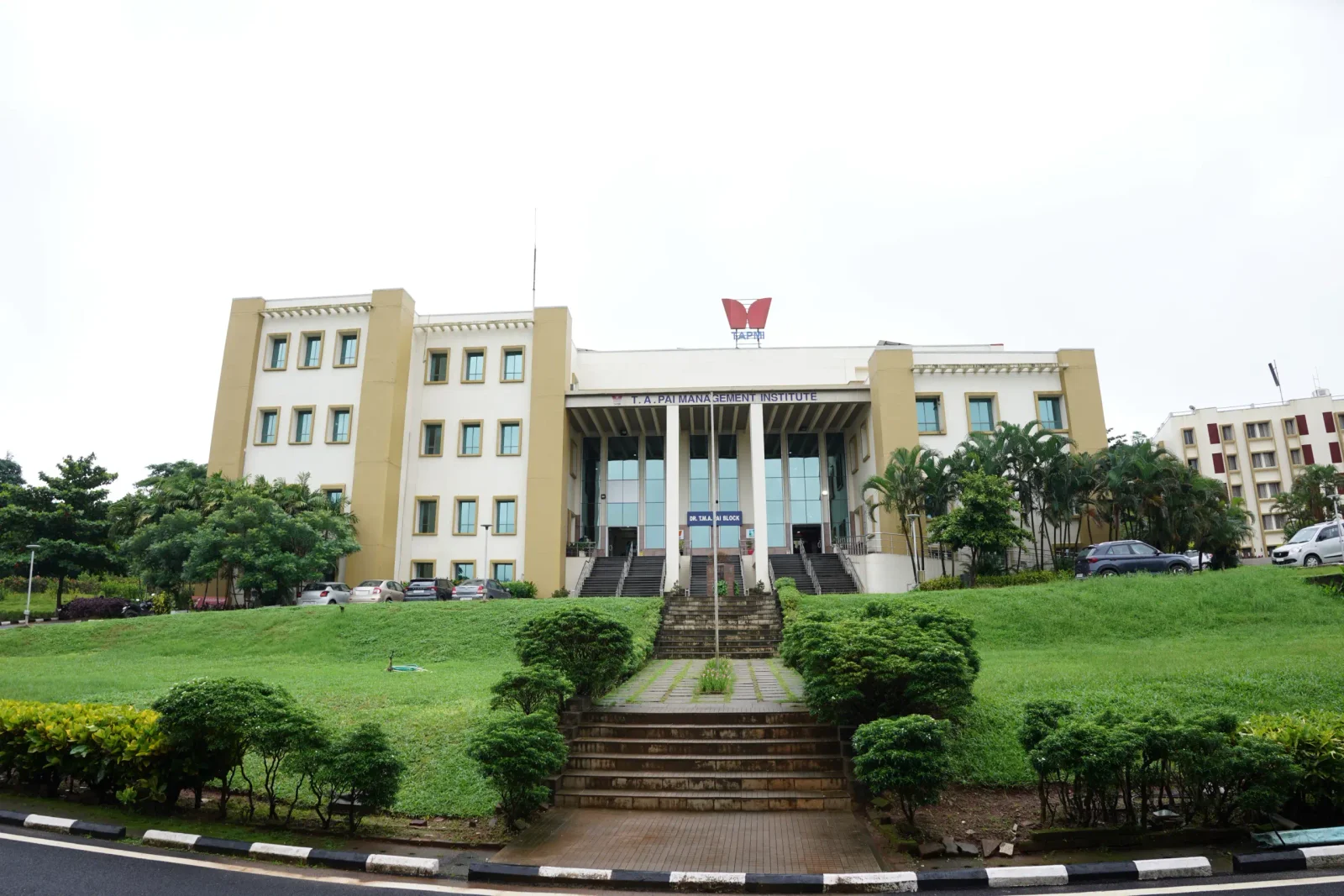
TAPMI has received prestigious international and national accreditations and is recognized for its academic quality, faculty expertise, industry engagement, and strong alumni network. The institute's Manipal campus provides students with modern academic infrastructure, residential facilities, libraries, sports amenities, and opportunities for multidisciplinary learning.
For students looking for a management programme that combines academic rigour, practical exposure, industry interaction, and leadership development, TAPMI PGDM is a prominent option among private B-schools in India.
T.A. Pai Management Institute (TAPMI), Manipal offers a rigorous, industry-oriented management education that combines academic learning with practical business exposure. The MBA programme focuses on developing leadership, analytical thinking, decision-making and problem-solving skills through case-based learning, projects, industry interaction and experiential activities.
Reputed management institute with a strong academic and industry orientation
Two-year full-time MBA programme
Admission through accepted management entrance examinations
Strong focus on leadership, analytics and strategic decision-making
Practical exposure through case studies, projects and industry interaction
Experiential learning through industry projects and corporate engagement
Strong corporate connections and active alumni network
Located in Manipal, Karnataka, a well-known education hub
Career opportunities across consulting, finance, marketing, operations, technology and other sectors
Particular Details Institute Name T.A. Pai Management Institute Popular Name TAPMI Manipal Established 1981 Location Manipal, Karnataka Institute Type Private Management Institute
Particular
Details
Institute Name
T.A. Pai Management Institute
Popular Name
TAPMI Manipal
Established
1981
Location
Manipal, Karnataka
Institute Type
Private Management Institute
Founder
Dr. T. A. Pai
Parent Institution
Manipal Academy of Higher Education (MAHE)
Flagship Programme
PGDM
Programme Duration
2 Years
Mode of Study
Full-Time Residential
Programme Type
Post Graduate Diploma in Management
Accreditations/Recognitions
AACSB and other applicable national/international recognitions
Entrance Exams
CAT, XAT, GMAT, NMAT
Work Experience
Not mandatory for the regular PGDM
Campus
Manipal, Karnataka
Official Website
TAPMI official website
TAPMI has built a strong reputation in management education through its academic standards, industry engagement, research activities, and emphasis on experiential learning. Accredi
TAPMI has built a strong reputation in management education through its academic standards, industry engagement, research activities, and emphasis on experiential learning.
Accreditation
TAPMI has received AACSB accreditation, an internationally recognized accreditation that evaluates business schools on areas such as academic quality, faculty, curriculum, research, student learning, and engagement with industry.
The institute also operates within the MAHE academic ecosystem, giving students access to a multidisciplinary university environment.
National Recognition
TAPMI is recognized for:
Strong academic and management education standards
Industry-oriented curriculum
Experiential learning methodology
Corporate engagement
Research and consulting activities
Management development programmes
Strong alumni network
Note: Rankings can change from year to year. Students should refer to the latest ranking publication and official TAPMI information before using a specific rank in admission decisions.
TAPMI is particularly suitable for students who want a management programme that combines classroom learning with practical business exposure. Key Reasons to Choose TAPMI Establish
TAPMI is particularly suitable for students who want a management programme that combines classroom learning with practical business exposure.
Key Reasons to Choose TAPMI
Established management institute with a long academic legacy.
Flagship two-year PGDM programme.
AACSB-accredited business school.
Strong association with the MAHE ecosystem.
Case-based and experiential learning.
Industry interaction and corporate projects.
Leadership development opportunities.
Business simulations and management games.
Strong focus on analytical and decision-making skills.
Experienced faculty and industry professionals.
Residential campus environment.
Dedicated career and placement support.
Active student clubs and committees.
Strong alumni network.
Exposure to multiple business domains.
The TAPMI PGDM is a two-year full-time residential management programme that provides students with a broad foundation in management during the initial stages and opportunities for
The TAPMI PGDM is a two-year full-time residential management programme that provides students with a broad foundation in management during the initial stages and opportunities for deeper learning through electives and specialized courses.
The programme focuses on developing:
Business knowledge
Analytical ability
Leadership skills
Communication
Decision-making
Strategic thinking
Team management
Problem-solving
Ethical and responsible management
TAPMI uses a combination of classroom teaching, case discussions, simulations, projects, presentations, industry interaction, and experiential learning.
Duration: 2 Years Mode: Full-Time Campus: Manipal, Karnataka Residential: Yes TAPMI PGDM Curriculum The PGDM curriculum is designed to provide students with a strong understanding
Duration: 2 Years
Mode: Full-Time
Campus: Manipal, Karnataka
Residential: Yes
TAPMI PGDM Curriculum
The PGDM curriculum is designed to provide students with a strong understanding of core management functions before allowing them to explore areas aligned with their career interests.
Core Management Areas
Students study subjects related to:
Marketing Management
Financial Management
Human Resource Management
Operations Management
Business Strategy
Economics
Business Analytics
Organizational Behaviour
Business Communication
Information Systems
Quantitative Methods
Strategic Management
Entrepreneurship
The curriculum may be updated periodically to reflect changes in industry requirements and emerging business practices.
Experiential Learning at TAPMI
One of TAPMI's important academic features is its emphasis on learning through practical business situations.
Students may participate in:
Case Studies
Business Simulations
Live Projects
Industry Projects
Management Games
Corporate Interactions
Presentations
Consulting Assignments
Internships
Capstone Projects
This approach helps students understand how management concepts are applied in real business environments.
Depending on the applicable programme structure and elective offerings, students can develop expertise in areas such as: Marketing Finance Human Resources Operations Business Analy
Depending on the applicable programme structure and elective offerings, students can develop expertise in areas such as:
Marketing
Finance
Human Resources
Operations
Business Analytics
Strategy
Information Technology
General Management
Banking and Financial Services
Product Management
Consulting
Entrepreneurship
Students should check the current academic structure before selecting electives because available courses and specialization options may change.
Candidates applying for the TAPMI PGDM need to satisfy the eligibility conditions prescribed for the relevant admission cycle. Educational Qualification Applicants generally need:
Candidates applying for the TAPMI PGDM need to satisfy the eligibility conditions prescribed for the relevant admission cycle.
Educational Qualification
Applicants generally need:
A bachelor's degree from a recognized university or institution.
The prescribed minimum aggregate marks as specified by TAPMI for the admission year.
Candidates in the final year of graduation may also be eligible, subject to applicable conditions.
Entrance Exam
Candidates may be considered through accepted management entrance examinations such as:
CAT
XAT
GMAT
NMAT
The exact examinations accepted and score validity requirements should be checked for the relevant admission cycle.
Work Experience
Work experience is not mandatory for the regular PGDM. Fresh graduates can apply, while relevant work experience may contribute to the overall candidate profile.
Admission to TAPMI PGDM involves multiple stages. The institute considers the candidate's entrance test performance along with academic record, profile, work experience where appli
Admission to TAPMI PGDM involves multiple stages. The institute considers the candidate's entrance test performance along with academic record, profile, work experience where applicable, and performance during the selection process.
Step 1: Entrance Examination
Candidates must appear for an accepted entrance examination such as CAT, XAT, GMAT or NMAT, depending on the applicable admission cycle.
Step 2: Online Application
Candidates complete the TAPMI application form and provide:
Academic details
Entrance exam details
Personal information
Work experience, if applicable
Other profile information
Step 3: Shortlisting
TAPMI evaluates applications based on factors that may include:
Entrance exam performance
Academic record
Work experience
Overall profile
Extracurricular achievements
Shortlisted candidates are invited to participate in the next stage.
Step 4: Selection Process
The selection process may include activities such as:
Personal Interview
Written/Analytical assessment
Group or case-based activities
Presentation or communication assessment
The exact selection components can vary by admission cycle.
Step 5: Final Selection
The final admission decision is based on the institute's prescribed selection criteria.
Candidates receiving an offer must complete:
Document verification
Fee payment
Admission formalities
Registration
TAPMI PGDM Cut-off
TAPMI does not necessarily publish a single permanent cutoff applicable to every candidate and every admission cycle. The effective shortlisting level can vary depending on:
Entrance examination
Applicant pool
Academic profile
Work experience
Programme requirements
Overall candidate profile
For SEO content, keywords such as TAPMI cutoff, TAPMI CAT cutoff, TAPMI XAT cutoff and TAPMI admission cutoff can be used, but an expected percentile should not be presented as an official cutoff unless released by the institute.
What Students Should Target
A competitive entrance score can strengthen the application, but admission should not be evaluated only on percentile. TAPMI follows a broader profile-based approach, making academic consistency, communication skills, work experience where applicable, and performance in the selection process important factors.
The TAPMI MBA/PGDM fee structure for the 2026–28 batch is approximately ₹20.1 lakh to ₹20.8 lakh for the complete two-year programme, excluding hostel and mess charges.
The TAPMI MBA/PGDM fee structure for the 2026–28 batch is approximately ₹20.1 lakh to ₹20.8 lakh for the complete two-year programme, excluding hostel and mess charges.
The additional training cost applies specifically to students enrolled in the MBA-BKFS programme.
Hostel and mess charges are not included in the programme fee and are payable separately. The final residential charges depend on the accommodation and the applicable fee structure
Hostel and mess charges are not included in the programme fee and are payable separately. The final residential charges depend on the accommodation and the applicable fee structure for the batch.
Students should also budget for:
Hostel accommodation
Mess/food expenses
Laptop and study materials
Personal expenses
Travel and transportation
Optional certifications or international programmes
Scholarships & Financial Assistance
TAPMI students may have access to scholarships and financial assistance based on the applicable institute and university policies.
Potential forms of assistance can include:
Merit-based scholarships
Need-based financial assistance
Government scholarships
Category-based scholarships
Other institutional scholarships
Students should check the latest scholarship notification for eligibility conditions, application deadlines, and award amounts.
Education Loan
Students admitted to TAPMI can explore education loans offered by public and private sector banks and financial institutions.
Education loans may cover eligible expenses such as:
Tuition fees
Hostel expenses
Books and study materials
Laptop
Other academic expenses
Loan approval depends on the bank's eligibility and lending policies.
TAPMI has a dedicated career services and placement ecosystem that supports students throughout their management programme. Placement preparation may include: Resume Development Mo
TAPMI has a dedicated career services and placement ecosystem that supports students throughout their management programme.
Placement preparation may include:
Resume Development
Mock Interviews
Aptitude Preparation
Group Discussions
Case Interview Preparation
Corporate Sessions
Career Counselling
Industry Interaction
Alumni Networking
Internship Support
Students can pursue careers across multiple sectors, including:
Consulting
Banking & Financial Services
Technology
FMCG
Manufacturing
Retail
E-Commerce
Healthcare
Logistics
Analytics
Insurance
General Management
TAPMI Placement Highlights
Placement figures vary from one graduating batch to another. Therefore, the latest official placement report should be used when publishing exact figures such as highest salary, average salary, median salary, number of recruiters, or placement percentage.
Particular Details Placement Support Dedicated Career Services Major Sectors BFSI, Consulting, IT, FMCG, Manufacturing, Retail Internship Support Yes Corporate Interaction Yes Care
Particular
Details
Placement Support
Dedicated Career Services
Major Sectors
BFSI, Consulting, IT, FMCG, Manufacturing, Retail
Internship Support
Yes
Corporate Interaction
Yes
Career Preparation
Yes
Alumni Networking
Yes
Note: Exact TAPMI placement statistics should be updated using the latest officially released placement report.
TAPMI graduates have opportunities to interact with recruiters across diverse industries. Banking & Financial Services ICICI Bank HDFC Bank Axis Bank Federal Bank Deloitte EY Consu
TAPMI graduates have opportunities to interact with recruiters across diverse industries.
Banking & Financial Services
ICICI Bank
HDFC Bank
Axis Bank
Federal Bank
Deloitte
EY
Consulting
Deloitte
EY
KPMG
Accenture
PwC
Technology
Infosys
TCS
Wipro
Cognizant
Accenture
FMCG & Consumer
HUL
ITC
Nestlé
Marico
Britannia
Other Sectors
Manufacturing
Insurance
E-Commerce
Retail
Healthcare
Logistics
Recruiter participation varies by year, programme and hiring requirements.
TAPMI is located in Manipal, Karnataka, a well-known education hub associated with the Manipal education ecosystem. The campus provides students with an environment designed for ac
TAPMI is located in Manipal, Karnataka, a well-known education hub associated with the Manipal education ecosystem.
The campus provides students with an environment designed for academic learning, residential life, extracurricular activities and professional development.
Students have access to facilities such as: Smart Classrooms Lecture Halls Case Discussion Rooms Computer Facilities Seminar Rooms Conference Facilities Group Discussion Areas Digi
Students have access to facilities such as:
Smart Classrooms
Lecture Halls
Case Discussion Rooms
Computer Facilities
Seminar Rooms
Conference Facilities
Group Discussion Areas
Digital Learning Resources
High-Speed Internet
Library
Students benefit from library and digital learning resources that support academic research and management studies.
Resources may include:
Books
E-Books
Business Journals
Research Databases
Newspapers
Magazines
Case Study Resources
Online Academic Resources
Hostel Facilities
TAPMI's PGDM is a residential programme.
Hostel facilities generally include:
Furnished Rooms
Internet Connectivity
Common Areas
Dining Facilities
Recreation Areas
Security
Laundry Facilities
Student Support Services
Sports & Recreation
Students can participate in a variety of sports and fitness activities, including:
Cricket
Football
Basketball
Volleyball
Badminton
Table Tennis
Indoor Games
Gym and Fitness Activities
Yoga
The wider Manipal campus environment also provides students with opportunities for extracurricular and recreational activities.
Student life at TAPMI combines academic learning with extracurricular activities, competitions, leadership initiatives and industry interaction. Students participate in: Management
Student life at TAPMI combines academic learning with extracurricular activities, competitions, leadership initiatives and industry interaction.
Students participate in:
Management Competitions
Case Competitions
Business Quizzes
Corporate Events
Cultural Activities
Sports Competitions
Leadership Activities
Entrepreneurship Initiatives
Social Responsibility Activities
These activities help students develop communication, teamwork, leadership and networking skills.
TAPMI has an active student-driven ecosystem with clubs and committees associated with various academic and extracurricular interests. Students can participate in activities relate
TAPMI has an active student-driven ecosystem with clubs and committees associated with various academic and extracurricular interests.
Students can participate in activities related to:
Marketing
Finance
Human Resources
Operations
Consulting
Analytics
Entrepreneurship
Cultural Activities
Sports
Media and Communication
Social Responsibility
Student organizations provide opportunities to take responsibility for events, manage teams and interact with corporate professionals.
TAPMI has experienced faculty members with backgrounds in: Management Economics Finance Marketing Operations Human Resources Strategy Business Analytics Information Technology Facu
TAPMI has experienced faculty members with backgrounds in:
Management
Economics
Finance
Marketing
Operations
Human Resources
Strategy
Business Analytics
Information Technology
Faculty members combine classroom teaching with research, consulting, case development and industry interaction.
The teaching approach emphasizes:
Case-Based Learning
Experiential Learning
Research
Business Simulations
Industry Projects
Classroom Discussions
Presentations
Research & Innovation
Research is an important component of TAPMI's academic ecosystem.
Faculty and students engage with research areas such as:
Finance
Marketing
Banking
Business Analytics
Strategy
Human Resources
Operations
Economics
Entrepreneurship
Sustainability
Digital Transformation
Research activities help students understand emerging business challenges and develop analytical thinking.
TAPMI provides opportunities for students to gain international exposure through academic and institutional initiatives. Depending on the applicable programme and academic year, op
TAPMI provides opportunities for students to gain international exposure through academic and institutional initiatives.
Depending on the applicable programme and academic year, opportunities may include:
International Exchange Programmes
Global Business Courses
International Study Opportunities
Faculty Interaction
Cross-Cultural Learning
International Academic Collaborations
International exposure can help students understand global markets and different approaches to business management.
TAPMI has a strong alumni community comprising management professionals working across sectors and geographies. Alumni can contribute to the student ecosystem through: Mentorship C
TAPMI has a strong alumni community comprising management professionals working across sectors and geographies.
Alumni can contribute to the student ecosystem through:
Mentorship
Corporate Interaction
Guest Lectures
Career Guidance
Networking
Internship Support
Industry Insights
Entrepreneurship Guidance
The alumni network can be particularly useful for students looking to understand career opportunities across different management functions.
A TAPMI PGDM can prepare graduates for careers across a wide range of business functions. Popular Job Roles Management Consultant Business Analyst Financial Analyst Investment Bank
A TAPMI PGDM can prepare graduates for careers across a wide range of business functions.
Popular Job Roles
Management Consultant
Business Analyst
Financial Analyst
Investment Banking Professional
Marketing Manager
Brand Manager
Product Manager
Business Development Manager
HR Manager
Operations Manager
Supply Chain Manager
Strategy Analyst
Risk Analyst
Relationship Manager
Project Manager
Industries
Graduates can explore opportunities in:
Banking & Financial Services
Consulting
Information Technology
FMCG
Manufacturing
Retail
E-Commerce
Healthcare
Insurance
Logistics
Analytics
Telecommunications
Startups
Important TAPMI Admission Dates 2026
Admission dates depend on the examination cycle and the institute's application schedule.
Expected Timeline Application Opens As announced by TAPMI Entrance Exam Registration As per CAT/XAT/GMAT/NMAT schedule TAPMI Application Deadline As announced by the institute Shor
Expected Timeline
Application Opens
As announced by TAPMI
Entrance Exam Registration
As per CAT/XAT/GMAT/NMAT schedule
TAPMI Application Deadline
As announced by the institute
Shortlisting
After application and score evaluation
Selection Process
As per institute schedule
Final Admission Offers
After completion of selection
Fee Payment
As specified in admission offer
Programme Commencement
As per academic calendar
Important: For a 2026 admission page, use the latest official TAPMI admission calendar instead of publishing unverified dates.
The value of a TAPMI PGDM should be assessed by comparing the total cost of education with career outcomes, industry exposure, alumni network, and long-term professional opportunit
The value of a TAPMI PGDM should be assessed by comparing the total cost of education with career outcomes, industry exposure, alumni network, and long-term professional opportunities.
Factor Benefit Programme Two-Year PGDM Accreditation AACSB Industry Exposure Strong Placement Support Dedicated Career Services Alumni Network Established Residential Campus Yes Ca
Factor
Benefit
Programme
Two-Year PGDM
Accreditation
AACSB
Industry Exposure
Strong
Placement Support
Dedicated Career Services
Alumni Network
Established
Residential Campus
Yes
Career Options
Multiple sectors
International Exposure
Available through academic initiatives
Students should compare the latest TAPMI PGDM fees with the latest official placement report when evaluating ROI.
Why TAPMI PGDM Stands Out
TAPMI has developed a distinctive position in management education through its combination of academic rigour and practical learning.
Key Differentiators
Established in 1981.
Strong academic legacy.
AACSB-accredited management school.
Part of the MAHE ecosystem.
Two-year residential PGDM.
Experiential and case-based learning.
Strong corporate engagement.
Business simulations and practical projects.
Experienced faculty.
Dedicated career support.
Diverse career opportunities.
Active student clubs and committees.
International exposure opportunities.
Established alumni network.
Manipal's strong educational ecosystem.
T.A. Pai Management Institute (TAPMI), Manipal is a reputed management institute offering a rigorous two-year PGDM programme for students seeking a combination of academic learning
T.A. Pai Management Institute (TAPMI), Manipal is a reputed management institute offering a rigorous two-year PGDM programme for students seeking a combination of academic learning, practical business exposure and leadership development.
The programme provides exposure to core management areas such as finance, marketing, human resources, operations, strategy and analytics, while experiential learning through cases, simulations, projects and corporate interaction helps students understand real-world business challenges.
With its AACSB accreditation, residential campus, experienced faculty, MAHE ecosystem, corporate engagement and established alumni network, TAPMI can be considered by students looking for a career-oriented PGDM in India.
Before applying, students should verify the latest TAPMI PGDM eligibility, entrance exam requirements, cutoff, fees, admission dates and placement statistics from the official institute information for the relevant admission year.
1. What is TAPMI Manipal? T.A. Pai Management Institute (TAPMI), Manipal is a management institute established in 1981 and located in Manipal, Karnataka. It is part of the Manipal
1. What is TAPMI Manipal?
T.A. Pai Management Institute (TAPMI), Manipal is a management institute established in 1981 and located in Manipal, Karnataka. It is part of the Manipal Academy of Higher Education ecosystem and is known for its PGDM programme.
The TAPMI PGDM is a two-year, full-time residential postgraduate management programme covering areas such as finance, marketing, operations, human resources, strategy and analytics
The TAPMI PGDM is a two-year, full-time residential postgraduate management programme covering areas such as finance, marketing, operations, human resources, strategy and analytics.
3. What is the duration of TAPMI PGDM?
The TAPMI PGDM is a two-year full-time programme.
4. What entrance exams are accepted by TAPMI?
Depending on the admission cycle, TAPMI may accept scores from CAT, XAT, GMAT and NMAT. Candidates should check the latest admission notification for the applicable exams.
5. Is work experience required for TAPMI PGDM?
No. Work experience is not mandatory for the regular TAPMI PGDM. Fresh graduates can apply if they meet the prescribed eligibility requirements.
Candidates need a bachelor's degree from a recognized university and must meet the minimum academic requirements specified by TAPMI for the relevant admission year.
Candidates need a bachelor's degree from a recognized university and must meet the minimum academic requirements specified by TAPMI for the relevant admission year.
TAPMI's effective cutoff can vary depending on the entrance examination, applicant pool and overall profile. Candidates should not treat an unofficial expected percentile as a guar
TAPMI's effective cutoff can vary depending on the entrance examination, applicant pool and overall profile. Candidates should not treat an unofficial expected percentile as a guaranteed TAPMI cutoff.
The TAPMI PGDM fee varies by admission year. The total cost can include tuition, institutional charges, hostel, mess and other applicable expenses. Students should refer to the lat
The TAPMI PGDM fee varies by admission year. The total cost can include tuition, institutional charges, hostel, mess and other applicable expenses. Students should refer to the latest official fee structure for the exact amount.
Yes. TAPMI PGDM is a residential programme, and students are provided access to campus accommodation and related residential facilities. 10. Is TAPMI PGDM good for freshers? Yes. F
Yes. TAPMI PGDM is a residential programme, and students are provided access to campus accommodation and related residential facilities.
10. Is TAPMI PGDM good for freshers?
Yes. Fresh graduates can apply for TAPMI PGDM if they meet the eligibility requirements. The programme provides foundational management education along with practical exposure through cases, projects, simulations and internships.
Yes. TAPMI provides dedicated career and placement support, including industry interaction, interview preparation, career counselling, internships and recruiter engagement.
Yes. TAPMI provides dedicated career and placement support, including industry interaction, interview preparation, career counselling, internships and recruiter engagement.
Graduates can pursue careers in consulting, finance, banking, marketing, sales, analytics, operations, human resources, technology, product management and general management. 13. I
Graduates can pursue careers in consulting, finance, banking, marketing, sales, analytics, operations, human resources, technology, product management and general management.
13. Is TAPMI AACSB accredited?
Yes. TAPMI has received AACSB accreditation, an internationally recognized accreditation for business schools.
14. Is TAPMI part of Manipal University?
TAPMI is part of the broader Manipal Academy of Higher Education (MAHE) ecosystem. Students benefit from the multidisciplinary academic environment associated with Manipal.
15. Is TAPMI PGDM residential?
Yes. The TAPMI PGDM is a full-time residential programme conducted at the Manipal campus.
TAPMI provides international exposure through applicable academic collaborations, exchange opportunities and global learning initiatives. Availability can vary by programme and aca
TAPMI provides international exposure through applicable academic collaborations, exchange opportunities and global learning initiatives. Availability can vary by programme and academic year.
17. Is TAPMI good for Finance?
TAPMI can be considered by students interested in finance, banking, financial services and related careers. The PGDM provides exposure to financial management and related business subjects.
18. Is TAPMI good for Marketing?
Yes. Students interested in marketing, sales, branding, consumer behaviour and product-related careers can explore relevant courses and career opportunities through the PGDM.
19. Is TAPMI good for Business Analytics?
TAPMI's PGDM includes quantitative and analytical learning that can support careers in business analytics, consulting, technology and data-driven management.
20. Is TAPMI worth it?
TAPMI can be a strong option for students seeking a residential PGDM with experiential learning, industry exposure, AACSB accreditation and access to the MAHE ecosystem. Students should compare the latest fees, placement outcomes, entrance requirements and their own career goals before making a final decision.